
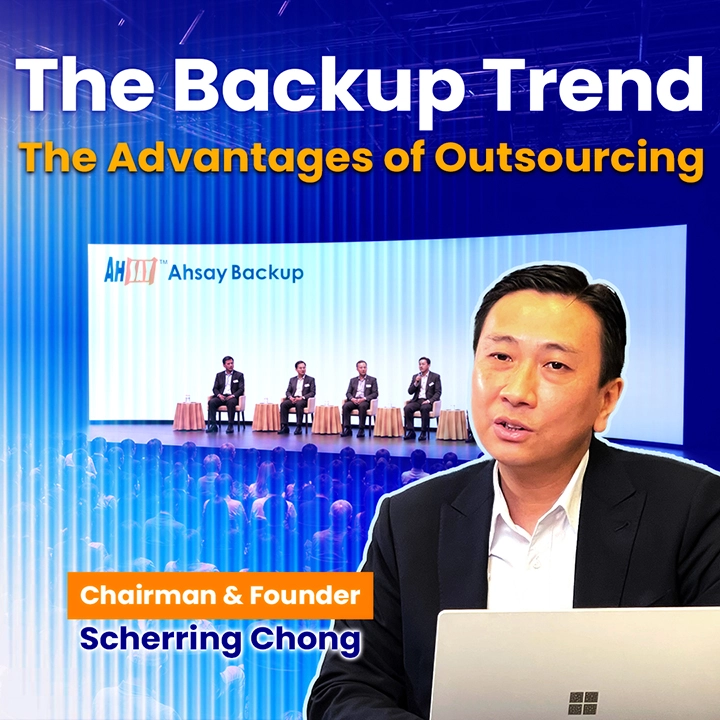
Scherring Chong, speaking in his capacity as the founder of Ahsay Backup, introduced the background of his company's self-developed backup software and shared the value of backup services in network security, along with the factors to consider when selecting a backup solution.
He pointed out that the focus of backup lies in whether data can be securely preserved and restored as needed after an incident occurs. Scherring also explained the value of outsourcing services and how backup solutions address the requirements of data integrity, availability, and confidentiality.
Background of Ahsay Backup
Ahsay Backup was established in the year 2000. It primarily develops its own backup software and sells software licenses to clients. Unlike suppliers who resell foreign solutions, our company provides self-developed solutions.
The company's daily operations focus on completing backups for different systems in the shortest possible time, with minimal resources, and in a secure manner.
Drawing on over two decades of experience, Scherring shared the role of backups in today's network security and the key considerations when selecting a backup solution.
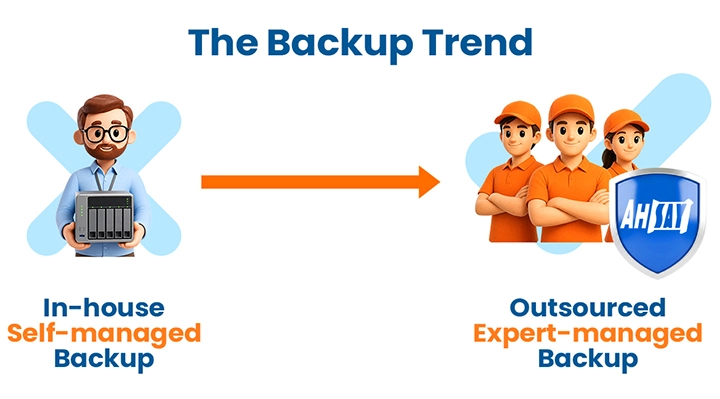
The Shift in Backup Models and the Advantages of Outsourcing
About ten years ago, the common practice was for companies to purchase hardware, servers, and software internally, running backups within their own server rooms. However, in the last three years, clients seeking new solutions have increasingly shifted towards outsourcing and the "Pay As You Go" model.
The outsourcing model reflects a client's need for a guarantee that data can be restored even if it is lost or compromised by a cyberattack, rather than simply owning hardware or software licenses.
Managing backups in-house requires inspecting operations and handling errors. In contrast, outsourced services are monitored by the service provider, who addresses issues and notifies the client for consultation when problems cannot be resolved. Backup systems may encounter issues due to configuration or execution environments, and professional service providers can more easily identify the root cause. Furthermore, companies can allocate their internal resources to maintain revenue-generating systems rather than backup systems.
Data Integrity: Immutability, Restoration Drills, and Monitoring
Backup data must remain in its original state; therefore, solutions should employ immutable storage. Scherring used the analogy of a CD-R, which cannot be rewritten once recorded, to explain that even hackers cannot modify the data within.
Storage hardware can degrade, and data saved for a period may become unreadable. Therefore, regular restoration drills are necessary.
Restoration drills involve retrieving the content of every data block and volume to restore the data, thereby verifying that there are no errors.
Network security threats occur daily. Solutions require a team to monitor the situation and check whether security patches or software updates need to be installed.
Data Availability: Backup Configuration and Restoration Speed
Beyond data integrity, it is crucial to be able to retrieve data after an incident. Scherring explained the configuration using the industry-standard "3-2-1" backup rule: three copies of data, stored on two different types of media, with one copy kept at an off-site location.
A combination of online and offline backups, such as using an air gap, can reduce the risk of hackers directly accessing and deleting tape backups from compromised machines. Restoration drills involve retrieving the content of every data block and volume to restore the data, thereby verifying that there are no errors.
When evaluating solutions, besides confirming data retrievability, one must consider the restoration time, known as the Recovery Time Objective (RTO). Keeping a copy of the data on-site can help speed up the restoration process.
Restoration capabilities must also cover specific time points. For example, if an intrusion occurred yesterday, the client may need to retrieve a backup from the day before or a specific point in time prior to the incident.
Data Confidentiality: Encryption Key Management and Dual Authentication
Encrypted data and encryption keys must be stored separately. If both are kept together, anyone who obtains the data could also obtain the keys, rendering the encryption useless.
Backup solutions need to manage encryption keys and use dual authentication to prevent unauthorized personnel from deleting backups. Even if a hacker gains access to the backup server, they must still pass a second layer of authentication to execute deletion operations.
Conclusion: Outsourced Backups and Seeking Professional Support
Scherring pointed out that in the current landscape where cyberattacks are frequent, establishing a backup solution with all necessary functions is not easy. Therefore, it is recommended to outsource these services to professionals.
He noted that if a company's data volume is not large, a comprehensive backup system might only cost between a few hundred to a thousand dollars per month.
When encountering backup issues, you can contact sales colleagues from Ahsay Backup. Regardless of whether the client has purchased services, the team will provide professional advice to assist in resolving the problem.


